Headless Gemini Enterprise: Exposing Managed Agents via a Streaming API to Build Your Own Agentic Platform
Out of the box, Gemini Enterprise gives organizations a turnkey, governed AI workspace. For end users, it looks like a unified, ready-to-use agentic platform: a web console where employees can chat with Gemini, run grounded enterprise search across internal documents, kick off deep multi-step research, discover and interact with hosted agents across your company, and take action across Google Workspace and connected business tools.
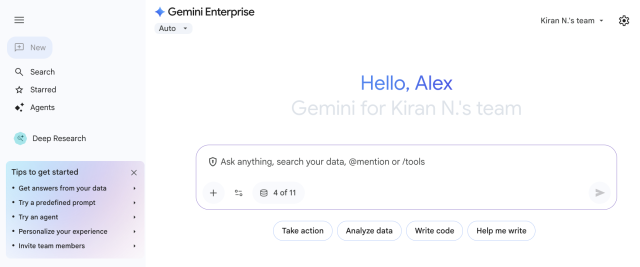
Unlike a basic chatbot that only answers questions, an agentic platform lets you automate real business processes end-to-end. You can deploy specialized agents powered by Gemini that reason over enterprise data, call internal APIs, run scripts and code inside isolated sandboxes, and execute either interactively in chat or on a schedule (such as recurring nightly reconciliations, inventory checks, or automated briefings).
For many teams, the default Gemini Enterprise console is all they need. But other organizations want to shape the platform around their own world. They may want a completely custom front-end design that matches their brand, workflows tailored to proprietary business processes, or a Bring Your Own (BYO) architecture—where they plug in their own fine-tuned domain models, custom MCP connectors, and specialized agents rather than adapting to a fixed SaaS interface.
You can do that with Gemini Enterprise, too. By running Gemini Enterprise headlessly—meaning you separate the AI engine from Google’s default web interface—you can expose Managed Agents and the Interactions API through a Server-Sent Events (SSE) Streaming API. In plain terms, instead of waiting for a full answer to finish, your custom app receives words, reasoning steps, and interactive data cards in real time as they are generated, while Google still handles the heavy lifting underneath (grounded search, isolated execution sandboxes, memory, and security governance).
The Business Case: One Headless Core, Five Bespoke Brands
To illustrate the multi-tenant complexity in practice, let’s walk through a concrete example where we model a main holding company with four daughter companies: a B2B record label and band management group called Gemini Vibe Records.
- The Parent Holding Company (Label HQ) needs centralized AI governance, shared operational agents (A&R demo evaluation, royalty & sync licensing, tour logistics, PR), Gemini Enterprise Search RAG (previously Vertex AI Search) grounding over master contracts and rate cards, and a control plane where platform admins can tune agent skills without redeploying code.
- The Subsidiaries (Four Performing Artists)—a metalcore band (Lorna Shoreline), a stadium rock act (The Goo Fighters), a pop star (Gemi Lovato), and an electronic dance act (Googillaz)—each have their own management, tour, and merchandise operations teams. They cannot share a single, mixed SaaS chat console: a tour manager working for Lorna Shoreline must never accidentally order tour T-shirts for Gemi Lovato, access another act’s contracts, or mix chat sessions across rosters.
+-------------------------------------------------------------------------------+ |
With a Headless Gemini Enterprise core, all five front-ends consume the exact same streaming API contract. Underneath, Identity Brokering (translating a user’s login into strict company permissions), Gemini Enterprise Search ACLs (document-level access filters), and remote MCP servers (standardized connectors to external business systems like inventory or royalty databases) enforce strict tenant isolation.
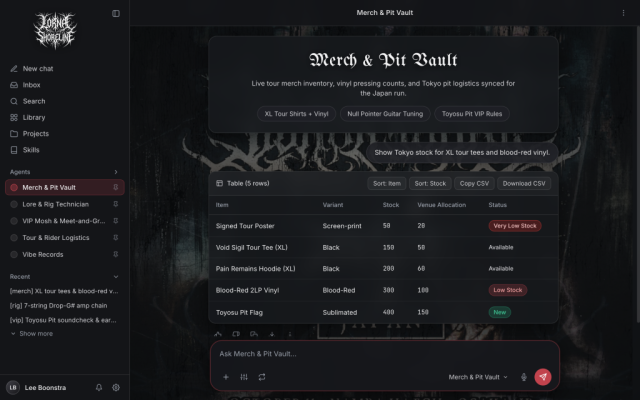
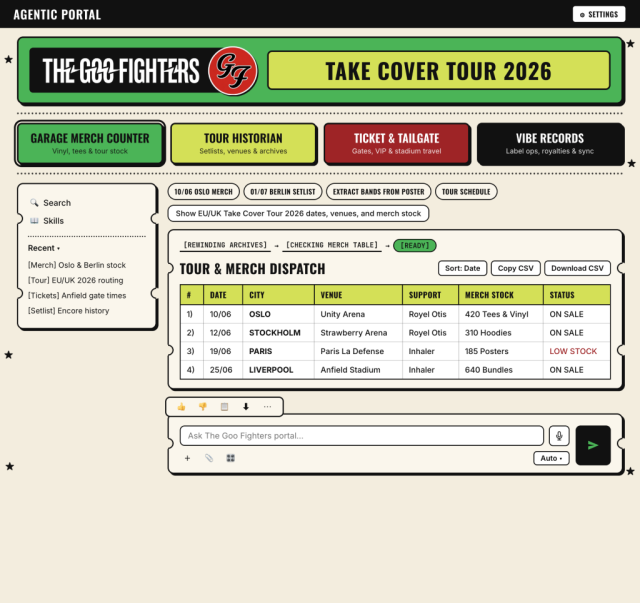
For example, the two custom artist management portals below—Lorna Shoreline’s dark Merch & Pit Vault and The Goo Fighters’ retro Take Cover Tour 2026 dispatch—look completely different, yet both render their agent lists, recent sessions, streaming status, and structured ui_card inventory tables from the exact same headless streaming backend:
Architecture Overview: Pure Headless Interactions API
To expose Managed Agents as a multi-tenant platform API, the cleanest pattern is a stateless streaming and control proxy (in my simple-to-explain example, I use FastAPI running on Cloud Run) sitting in front of the Gemini Enterprise Platform. Think of this proxy as a lightweight traffic cop: it does not store conversation history itself, so it can scale down to zero when idle and spin up instantly when traffic arrives. Its only job is to check who the caller is, enforce their permissions, and forward the live stream.
[ Bespoke BYO UIs (SSE / WS) | External A2A Agents | Replicator / CLI ] |
Why API-First Interactions Beat CLI Wrapping
A common shortcut when prototyping agent platforms is wrapping a local agent CLI—such as the Antigravity CLI (agy), Google’s terminal-based AI coding and agent-orchestration CLI (available from antigravity.google/download)—in a subprocess pool and piping stdout to a web socket. While agy is great for local skill authoring, interactive workflows, and single-developer prototyping, wrapping a CLI subprocess for a multi-tenant production platform creates operational bottlenecks: OS subprocesses, stdin/stdout pipe locks, and stateful worker affinity that prevents scale-to-zero.
Using the Pure Headless Interactions API (client.interactions.create(..., stream=True) over HTTPS) solves this cleanly:
- True Serverless Scale: The Cloud Run proxy holds no subprocesses and no in-memory conversation state, allowing it to scale to zero and handle bursty multi-tenant traffic.
- Managed Agents & Isolated Sandboxes: In Gemini Enterprise, Managed Agents are config-driven, autonomous agents hosted and executed entirely by Google Cloud—you define the model, instructions,
SKILL.mdskills, and MCP tools via the Agents API without building or operating your own agent runtime or container fleet. Behind the Interactions API, Google runs the Antigravity agentic harness inside an isolated Linux sandbox environment (“capsule”) with built-inbashand filesystem tools, handling multi-step tool loops, context caching, and async background execution (background=true) automatically. - Per-Request Identity Brokering: Every incoming request carries a scoped OIDC/JWT token that the proxy resolves into tenant claims, Gemini Enterprise Search RAG filters, and remote MCP authorization headers before the model ever runs.
How Managed Agents & Stateful Sessions Work
Even though the Cloud Run proxy is completely stateless, conversations remain stateful across turns by delegating session continuity to the Interactions API and Memory Bank.
1. Stateless Proxy, Stateful Sessions (previous_interaction_id)
- Turn 1: The client sends
POST /api/chat/streamwithout aninteraction_id. The proxy invokesclient.interactions.create(..., stream=True), receives a newinteraction_idin theinitanddoneframes, and persistslast_interaction_idin the tenant-scoped session index (e.g., Firestore). - Turn 2+: The client sends the next prompt with its
session_id. The proxy looks upsession.last_interaction_idand passes it asprevious_interaction_idtoclient.interactions.create(...). Gemini Enterprise automatically reconstructs the prior turn history, tool outputs, and context cache server-side.
2. Inside a Single Turn
Each agent is registered in the Agents API (projects/{project}/locations/{location}/agents/{agent_id}) with a target model (such as gemini-4-hydrogen on location="global" or a custom fine-tuned Vertex AI endpoint), system instructions, and bound tools:
- Gemini Enterprise Search RAG: Grounding queries execute with the caller’s brokered
tenant_idfilter—for example,tenant_id: ANY("<tenant_id>", "shared-policy"). Unauthorized documents never enter the model’s context window, and returnedgroundingChunksare normalized intorag_citationSSE events. - Remote MCP Tools: The proxy forwards signed tenant or SPIFFE claims to remote MCP servers (such as merch inventory, royalty ledgers, or ticketing APIs), emits
tool_callandtool_resultSSE events, and maps structured tool responses into typedui_cardSSE events. - Google Workspace (3-Legged OAuth): For user-scoped Workspace actions (Drive, Docs, Sheets, Gmail, Calendar), the proxy exchanges per-user OAuth tokens from Secret Manager or an OAuth vault so Workspace MCP connectors act strictly with the caller’s actual permissions rather than a shared service account.
- Deep Research & Async Jobs (
background=true): Long-running synthesis tasks triggered viaPOST /api/jobsrun asynchronously withbackground=true, streaming structured progress and persisting final artifacts to tenant-scoped Cloud Storage prefixes (gs://<bucket>/tenants/<tenant_id>/artifacts/).
Exposing the Streaming API (Data Plane)
In platform architecture, the Data Plane is the live traffic lane where user messages, search results, and AI responses flow in real time. To let any front-end—whether a React dashboard, a mobile app, or a custom artist management portal—render rich agentic experiences without tying itself to Gemini-specific SDK internals, the proxy exposes a normalized Data Plane and a Canonical SSE Event Schema.
Core Data Plane Endpoints
| Endpoint | Transport | Purpose |
|---|---|---|
POST /api/auth/token |
HTTP JSON | Exchanges credentials or persona context for a scoped JWT (tenant_id, role). |
POST /api/chat/stream |
HTTP SSE (text/event-stream) |
Primary stateless streaming endpoint for all white-label UIs. |
WS /ws/chat |
WebSocket | Bidirectional streaming for interactive builders needing mid-turn cancellation. |
POST /api/chat |
HTTP JSON | Non-streaming fallback returning the completed run payload. |
POST /api/jobs |
HTTP JSON (202 Accepted) |
Triggers background=true async interactions for long-running research or Cloud Scheduler jobs. |
GET /api/jobs/{interaction_id} |
HTTP JSON / SSE | Polls or attaches to an in-flight background interaction. |
GET /api/sessions |
HTTP JSON | Lists tenant- and user-scoped conversation sessions for sidebar history. |
GET /api/sessions/{session_id} |
HTTP JSON | Retrieves session metadata, last_interaction_id, and message history. |
PATCH /api/sessions/{session_id} |
HTTP JSON | Updates session metadata (such as pinned state). |
DELETE /api/sessions/{session_id} |
HTTP 204 No Content |
Deletes a tenant-scoped session. |
POST /api/files |
Multipart HTTP JSON | Uploads files to tenant-scoped GCS and returns an artifact_uri for chat turns. |
The Canonical SSE Event Schema
Every front-end consumes the exact same SSE frame format (event: <type>\ndata: <json>\n\n). Think of it like a universal shipping container: the backend sends standardized data packets, and each brand’s front-end decides how to display them on screen. Separating what the event means from how it looks is what allows five radically different UIs to share one backend:
| Event Type | Payload Fields | Purpose |
|---|---|---|
init |
interaction_id, session_id, agent_id, tenant_id, model |
Emitted at stream start with resolved tenant and session context. |
thought |
step, label, detail |
Intermediate reasoning/planning steps (rendered as an amp-stack signal chain, tape counter, or BPM telemetry depending on the UI). |
tool_call |
call_id, tool_name, server, args |
Remote MCP or Search tool invocation (sensitive arguments redacted via Model Armor / DLP). |
tool_result |
call_id, tool_name, status, summary |
Tool execution outcome returned to the model. |
rag_citation |
citation_id, datastore_id, title, uri, snippet, page |
Grounded Gemini Enterprise Search RAG source chunk (rendered as contract chips or tour memos). |
ui_card |
card_type, schema_version, data |
Structured domain payload (catalog_grid, product_card, bundle_quote, order_receipt, event_schedule, data_table). |
delta |
text |
Incremental assistant markdown/text token delta. |
done |
interaction_id, usage (input_tokens, output_tokens, search_queries, tool_calls), latency_ms |
Final frame; client stores interaction_id as previous_interaction_id for the next turn. |
error |
code, message, retryable |
Structured error (e.g., 403 TENANT_ISOLATION_VIOLATION, 429 QUOTA_EXCEEDED). |
Streaming Request Flow in Python
Inside the FastAPI streaming handler, the proxy authenticates the caller, builds the tenant-scoped Discovery Engine filter and signed MCP claims, and streams normalized frames from the google-genai client:
from fastapi import APIRouter, Depends |
On the client side, a lightweight shared JavaScript SDK (fetch + ReadableStream) reads each incoming event, updates the session_id, and hands ui_card data to each brand’s native UI components. Because ui_card carries pure structured data (catalog_grid, bundle_quote, data_table) rather than pre-styled HTML, the metalcore ops portal renders a high-contrast crimson-and-black card while the pop management portal renders an iridescent rounded card—zero backend changes required.
Control Plane & Hot-Swappable Skills
While the Data Plane handles live chat traffic, the Control Plane is the admin settings layer where platform owners configure tenants, agents, data sources, and skills. A platform is only useful to enterprise teams if domain owners can tune agent behavior without waiting on a software deployment. The Control Plane manages tenants, Agents API registrations, datastores, MCP bindings, and a live Skill Registry.
Agents vs. Skills: Holding Company Control & Subsidiary Autonomy
Before looking at how skills are updated at runtime, it helps to separate what an Agent is from what a Skill is:
- What an Agent Is (The Persona & Runtime Binding): An Agent is a configured, goal-oriented assistant registered in the Agents API (
model, system instructions, bound Gemini Enterprise Search RAG datastores, remote MCP servers, and attached skills).- Example — The T-Shirt & Merch Ordering Agent: Every artist team uses a Merch Ordering Agent connected to the
merch-mcpserver (list_products,check_size_stock,quote_bundle,submit_order). When a tour manager for Lorna Shoreline asks for Tokyo stock on XL tour tees and blood-red vinyl, the agent queries only Lorna Shoreline’s inventory partition and streams back a structuredui_cardorder table—never touching Gemi Lovato’s catalog.
- Example — The T-Shirt & Merch Ordering Agent: Every artist team uses a Merch Ordering Agent connected to the
- What a Skill Is (The Portable Business Rule): A Skill is a modular, reusable instruction package defined in a portable
SKILL.mdfile with typed parameters. It teaches an agent how to execute a specific business rule or workflow without touching application code.- Example Skill —
create_tour_merch_bundle: Defines the exact sizing ratios, minimum order quantities, and restock discount rules (for example,bulk_tee_discount_pct: 15when ordering 100+ XL tour tees alongside vinyl) that the Merch Ordering Agent follows whenever a tour manager requests a bundle quote.
- Example Skill —
In a holding-company model like Gemini Vibe Records, this separation unlocks both centralized governance and local autonomy:
- Top-Down Distribution: Label HQ can centrally author and push standardized agents—such as the T-Shirt & Merch Ordering Agent or Tour & Rider Logistics Agent—and baseline compliance skills down to all four artist subsidiaries at once.
- Subsidiary Customization: Each daughter company can also create its own unique, tenant-isolated agents and skills tailored to its own operations—for example, Lorna Shoreline’s Lore & Rig Technician agent (with a skill for guitar tunings and amp chains) or Googillaz’s Track-ID & BPM Detective—without exposing them to sibling acts.
That combination—centralized governance pushed from the top, paired with local agent and skill creation at the edges—is the whole core and purpose of building your own agentic platform.
Control Plane Endpoints
| Endpoint | Method | Purpose |
|---|---|---|
/api/tenants |
GET, POST |
List or onboard parent/child tenants and their datastore/RBAC scopes. |
/api/agents |
GET, POST, PUT |
Register or update agent resources via the Agents API. |
/api/skills |
GET, POST |
List or register modular skills (SKILL.md + parameter JSON/YAML). |
/api/skills/{skill_id} |
GET, PUT, DELETE |
Read or hot-swap a skill’s instructions or parameters and patch the bound agent. |
/api/datastores |
GET, POST |
Register Gemini Enterprise Search RAG datastores and their tenant_id ACL filter templates. |
/api/mcp-servers |
GET, POST |
Register remote MCP server endpoints, Secret Manager refs, and egress allowlists. |
How Hot-Swappable Skills Work
- Author: A skill is defined as a portable
SKILL.mdfile paired with typed parameters (e.g.,quote_sync_licensewithindie_film_discount_pct: 15). Live transactional data stays out ofSKILL.mdand lives in MCP tools or Gemini Enterprise Search RAG. - Edit Live: A Label HQ admin opens the Skill Studio in the UI, changes
indie_film_discount_pctfrom15to25, and saves (PUT /api/skills/quote_sync_license). - Instant Effect: The proxy validates the schema, versions the skill in Firestore, and patches the bound agent via the Agents API (
UpdateAgent) or passes the updated skill version override on the nextinteractions.createcall. The very nextPOST /api/chat/streamrequest reflects the updated rule immediately.
Multi-Tenancy, Double-Fence Security & Governance
In a B2B2X architecture, prompt instructions alone are never a security boundary. Even if a user attempts a prompt injection across tenants (for example, a manager for The Goo Fighters trying to query Gemi Lovato‘s royalty ledger), the platform enforces Double-Fence Isolation:
- Proxy RBAC Gate: The FastAPI middleware validates the caller’s OIDC/JWT before
interactions.createis ever called, verifying that(user_id, tenant_id, role)has permission to invoke the requestedagent_id. - Gemini Enterprise Search ACL Filters: Every retrieval call injects a mandatory
tenant_idfilter (tenant_id: ANY("<tenant_id>", "shared-policy")), preventing cross-tenant documents from entering the model’s context. - Remote MCP Row-Level Isolation: The proxy forwards signed tenant claims (or a SPIFFE SVID—a verifiable digital ID badge for the agent) to remote MCP servers. Each MCP server independently filters database rows by
tenant_idand returns403 TENANT_ISOLATION_VIOLATIONon mismatch. - Model Armor & Secret Manager: Model Armor inspects inputs and tool arguments for prompt injections or PII leaks before execution. Remote MCP credentials and third-party API keys are stored in Google Cloud Secret Manager (
auth_secret_ref)—never hardcoded in manifests orSKILL.md. - B2B2X Usage Metering & Evaluation: The
doneSSE event emitsinput_tokens,output_tokens,search_queries, andtool_callsper tenant into Cloud Monitoring or BigQuery for subsidiary chargebacks, whileinteraction_idtraces flow to the Evaluation Hub to track groundedness and tool accuracy.
Making Your Platform Agent-Ready: A2A & Declarative Manifests
Exposing a human-facing streaming UI is only half the story. Modern agentic platforms also need to be callable by external agents and replicable across environments.
Agent-to-Agent (A2A) Protocol Surface
The Agent-to-Agent (A2A) protocol is a shared standard that lets one AI agent ask another AI agent for help—much like an API between two software services. By exposing standard A2A endpoints alongside /api/chat/stream, parent Label HQ agents can delegate tasks to child artist agents, or external enterprise systems can invoke your platform directly without scraping UI streams:
GET /.well-known/agent.json— Platform-level A2A Agent Card advertising capabilities, auth schemes (OIDC/SPIFFE), and tenant discovery.GET /tenants/{tenant_id}/agents/{agent_id}/.well-known/agent.json— Tenant- and agent-specific Agent Card listing declared skills and output modes.POST /a2a/tasks/send— Synchronous A2A task execution (maps to non-streaminginteractions.create).POST /a2a/tasks/sendSubscribe— Streaming A2A task execution (maps tointeractions.create(..., stream=True)over SSE).
Discovery & Declarative Replication (PlatformManifest)
To make the platform self-describing—so developers or automated setup tools can inspect what agents exist and spin up an identical copy in a new environment—expose discovery endpoints (/developers, /openapi.json, /llms.txt, /llms-full.txt) alongside a blueprint API (GET /api/manifest.json and POST /api/manifest/apply):
apiVersion: headless-ge.octo.dev/v1 |
Always enforce two invariants on the manifest surface: never inline raw secrets (emit auth_secret_ref Secret Manager paths instead), and enforce caller RBAC on GET /api/manifest.json so child tenants cannot enumerate sibling tenants, agents, or datastores.
Wrapping Up
You do not need to accept a one-size-fits-all chat console to get the enterprise security, grounding, memory, and sandboxed execution of Gemini Enterprise. By placing a stateless Cloud Run proxy in front of Managed Agents and the Interactions API, normalizing responses into a canonical SSE Streaming API, and enforcing Double-Fence Isolation across Gemini Enterprise Search RAG and remote MCP servers, you can turn Gemini Enterprise into the headless engine behind any white-label or multi-tenant agentic platform.
Further Reading & Official Documentation
- Gemini Enterprise Concepts & Overview — Core architecture, data stores, blended search, and enterprise governance.
- Managed Agents API on Gemini Enterprise Agent Platform — Overview of the Managed Agents runtime, isolated sandboxes, and REST-first agent management.
- Interact with Managed Agents — Multi-turn session state, runtime payloads, and dynamic configuration overrides.
- Managed Agents Sandbox Environment & Skills — Container isolation,
SKILL.mdmounting, and built-in sandbox tools. - Interactions API Overview — Stateful
interactions.createinterface,previous_interaction_id, streaming, andbackground=trueexecution. - Memory Bank on Gemini Enterprise Agent Platform — Persistent, cross-session memory generation and retrieval for personalized agent continuity.
- Register and Manage A2A Agents in Gemini Enterprise — Connecting and orchestrating Agent2Agent (A2A) services on Google Cloud.

About the Author
Lee Boonstra is a Staff AI Software Engineer & Advocate in the Google Cloud Office of the CTO (Applied Innovation Factory). They specialize in secure multi-agent systems, frontier LLMs, and voice technology. Lee is the author of reference books for O'Reilly and Apress, and the viral Kaggle/Google Prompt Engineering whitepaper.