The Myth of the Neutral Default: Why Generative AI Reflects Our Blind Spots (And How to Engineer Around Them)
Two identical resumes land in an automated hiring pipeline: same degree, same ten years of engineering experience, same open-source contributions. The only difference is the name at the top of the page.
The LLM-powered screening tool scores the batch, and the resume with a white-sounding name ranks as the stronger candidate up to 85% of the time.
But why? Isn’t this racism at its core?
Meanwhile, in a municipal social care pilot, caseworkers test an LLM to summarize patient intake notes. Two patients present the same mobility and health challenges. For the male patient, the model writes that he has a “complex medical history”—language that triggers higher-tier care funding. For the female patient, the model softens the same symptoms into “personal resilience,” quietly putting her support package at risk.
Nobody wrote an if (gender == "female") downgrade() rule in either system. No malicious prompt, no broken API call, and no server error in the logs. In both cases, the model did exactly what its mathematics told it to do: it predicted the most statistically probable continuation of the text based on patterns learned from billions of historical documents.
When we deploy generative AI into hiring, healthcare, public administration, or global marketing without understanding those statistical defaults, we don’t get neutrality. We get automated bias at scale.
In this post, we’ll unpack why Large Language Models (LLMs) act as statistical mirrors rather than objective reasoning engines, trace how bias has evolved from classic tabular classifiers to modern generative models, and walk through a four-pillar engineering approach—spanning Model Selection, Grounded Prompt Architecture, Curated Data, and Human Gatekeeping—to keep your AI systems fair and brand-safe.
Statistical, Not Factual: Why Models Stereotype
When you interact with a frontier LLM, it is easy to fall into the illusion that the model “thinks” or “reasons” like a human colleague. Mechanically, an LLM is a next-token prediction engine. It ingested massive crawls of the open web and learned the deep statistical syntax of human communication—but it absorbed patterns, not conscious knowledge.
An LLM does not have a SQL database of validated facts sitting inside its weights. Every time it drafts a job evaluation, summarizes a clinical note, or generates ad copy, it is asking one mathematical question:
“Given every token that came before, what token is statistically most likely to come next?”
That single mechanism explains both hallucinations and algorithmic bias. A hallucination isn’t a model “lying” to you; it is ungrounded creative prediction doing what the math dictates. Similarly, a stereotype isn’t the model holding a personal prejudice; it is the model following the statistical majority of its training corpus.
That brings us to an uncomfortable truth about frontier models. Whether you look at OpenAI’s GPT family, Google’s Gemini, or xAI’s Grok, the exact training recipes are closely guarded corporate secrets. But we do know they ingest massive crawls of the public internet—and the source matters immensely.
Take xAI’s Grok, which was intentionally trained on real-time, unfiltered X (formerly Twitter) data and marketed as “anti-woke.” When you train a next-token predictor on unfiltered social media arguments and internet outrage, you bake polarization, hostility, and raw societal bias directly into the model’s baseline weights.
The Internet Mirror: If you feed a model the open internet, it reflects the internet’s worst habits to you—packaged in confident, grammatically flawless prose.
The Myth of the “Neutral Default”
Why do engineering teams miss these blind spots before shipping? Because humans have long mistaken the dominant perspective for a universal standard.
In product engineering, a default is simply the implicit assumption a team subscribes to without conscious awareness. Long before generative AI, that habit caused real harm in the physical world:
- Automotive Safety: Until 2011, the U.S. Department of Transportation did not require female body-type crash test dummies in regulatory safety testing. Because vehicle interiors and restraints were engineered around the “average male” reference frame, female drivers became 47% more likely to be severely injured in comparable car accidents.
- Color Film Calibration: Until the 1990s, virtually all color calibration for photographic film (Kodak’s “Shirley cards”) was tuned to Caucasian skin tones, leaving darker skin tones muddy and underexposed. Kodak only invested heavily in supporting a broader range of brown tones after receiving persistent complaints from chocolatiers and wood furniture manufacturers whose products were losing detail on film.
Nobody in those engineering rooms woke up intending to build an exclusionary product. They made choices that felt obvious to the people in the room. Machine learning systems inherit that same blind spot—except now we encode it into model weights and deploy it at millions of requests per second.
From Classification Bias to Generative Bias
A few years ago, conversations about ML fairness focused almost exclusively on discriminative and classification algorithms—models predicting creditworthiness, scoring resumes, or flagging fraud from imbalanced tabular datasets. Those systems produced some of the most infamous algorithmic failures in recent memory:
- Voice Recognition (ASR): Research highlighted in Harvard Business Review by Joan Palmiter Bajorek showed that commercial speech recognition engines exhibited substantially higher word error rates for female voices and racial minorities because acoustic models were trained predominantly on standard male dialects.
- Healthcare Triage: A widely deployed U.S. hospital algorithm used historic healthcare spending as a proxy for medical need. Because Black patients historically had lower healthcare spending due to unequal access, the system systematically underestimated their illness severity and steered them away from high-risk care programs.
- Recruiting & HR: Amazon scrapped an experimental AI hiring tool after discovering it penalized resumes containing the word “women’s” (such as “women’s chess club captain”) because it was trained on a decade of male-dominated tech resumes.
- Financial Services: Regulators investigated the Apple Card credit algorithm after women—including spouses sharing joint assets—received significantly lower credit limits than their husbands despite having equal or higher credit scores.
- Public Sector: In the Netherlands, the Dutch Childcare Benefits Scandal (Toeslagenaffaire) demonstrated the devastating human cost of automated risk profiling. The Dutch Tax & Customs Administration deployed self-learning algorithms where “dual nationality” was treated as an indicator of fraud risk, falsely accusing 26,000+ families and plunging thousands into financial ruin.
In the Generative AI era, bias operates differently—and often more visibly. Instead of hiding inside an opaque credit score, generative bias surfaces directly in synthesized text, avatars, and imagery:
- Over-Sexualization in Avatars: When women uploaded professional headshots to avatar generators like Lensa AI, they frequently received hyper-sexualized, stripped-down images without consent, while male uploads were rendered as astronauts and corporate executives.
- Professional Stereotyping: Unconstrained text-to-image models generated 100% white, male portraits for prompts like “STEM professional” or “CEO,” while low-paying domestic roles defaulted to women and minorities.
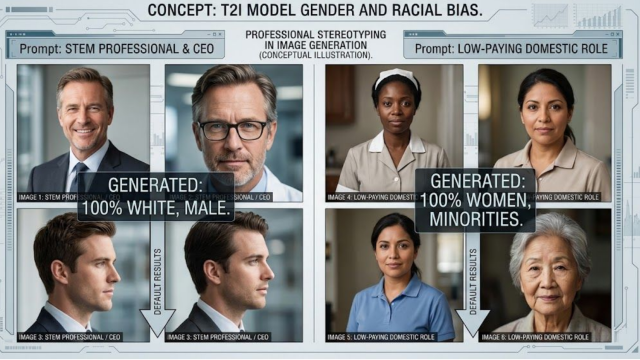
Bias becomes especially dangerous when it touches protected or sensitive dimensions: race and ethnicity, gender, sexuality, age, ability, level of education, disposable income, religion, and political view.
| Dimension | Traditional ML Bias (Classification) | Generative AI Bias (Foundation Models) |
|---|---|---|
| Primary Mechanism | Skewed tabular features or proxy variables (e.g., zip code, historic spending) | Next-token probability learned from open-web text, code, and media |
| Failure Mode | Disparate false-positive / false-negative rates across protected groups | Stereotypical defaults, erasure, tone shifts, and ungrounded fabrication |
| Visibility | Often hidden inside opaque risk scores until audited | Directly visible in customer-facing copy, avatars, and chat responses |
| Fixability | Feature removal, threshold calibration, dataset rebalancing | Multi-layered: model selection, grounded RAG, system prompts, and HiL review |
The Brand Safety Hazard (And Why Code Patches Fail)
For marketing teams, agencies, and customer-facing product builders, unchecked generative bias is an immediate brand safety hazard. Unleashing uncurated GenAI into campaign production risks alienating key demographics or amplifying harmful stereotypes under your company’s logo.
Fixing it isn’t as simple as adding a naive guardrail in code. We have all seen high-profile industry failures where teams tried to patch bias through crude backend prompt injection—silently rewriting user prompts to force diversity—only to trigger severe over-corrections, such as generating historically inaccurate representations in period contexts.
NOTE: Bias in Generative AI cannot be solved purely with automated patches in code. An algorithm has zero cultural sensitivity; it requires human brand guardians who understand cultural context, intersectionality, and nuance.
If crude background prompt hacks fail, what does a reliable engineering strategy look like? It requires deliberate architecture across four layers of your stack.

1. Model Selection & Inclusive Benchmarks
Stop treating foundation models as interchangeable black boxes. Choose models with transparent system cards, documented evaluation benchmarks, and clear safety architectures.
2. Grounded Prompt Architecture
Never ship open-ended, lazy prompts in production. An unconstrained prompt like “Generate a portrait of a successful founder” forces the model to fall back on its statistical open-web default.
Instead, anchor the model with explicit system instructions, inject verified grounding data, and provide few-shot counter-stereotypical examples or explicit diversity constraints where appropriate.
Here is how you can structure a grounded, brand-safe Vertex AI prompt configuration using Python and the google-genai SDK—explicitly separating creative requirements from demographic assumptions:
from google import genai |
NOTE: Temperature is kept low (0.4) here. Turning up an LLM’s “creativity” setting (temperature) does not actually make the model more creative or original—it simply flattens the token probability distribution. It injects more randomness into sampling, making the model more likely to pick lower-probability words and increasing the odds of hallucinations and off-brand noise.
TIP: Treat prompt templates like production code. Version-control them, test them against adversarial edge-case inputs (such as varied names, dialects, and cultural contexts), and measure output consistency before shipping.
3. Fine-Tuning & RAG on Curated Data
Do not let enterprise applications rely solely on parametric memory from the open web. Ground your workflows using Retrieval-Augmented Generation (RAG) backed by brand-verified, diverse datasets, or fine-tune smaller task-specific models on curated, audited examples.
And remember: data labeling is never neutral. If your labeling team lacks domain or cultural context—whether distinguishing product styles or interpreting regional slang—those blind spots get baked straight into your ground truth. Test your datasets and prototypes with diverse real users early.
4. Human Creative Gatekeeping
Establish strict Human-in-the-Loop (HiL) review gates before generative assets reach customers, patients, or campaigns. Automated classifiers and LLM-as-a-judge evaluators can catch obvious policy violations, but they cannot catch quiet cultural misfires.
The Human Advantage
Modern AI excels at raw throughput. It can generate 1,000 ad copy variations in ten seconds, render cinematic video clips, optimize real-time bids across search campaigns, and transcribe noisy drive-thru audio.
Yet speed and volume are not the same as judgment. The capabilities that turn raw computation into trustworthy, inclusive, and genuinely remarkable work remain uniquely human:
- Empathy, Lived Experience & Cultural Nuance: An LLM has never felt out of place in a room, sat in a clinic as an underrepresented patient, or caught the fine line between dry Dutch sarcasm and genuine hostility. It interpolates text; it does not live a life. That lived experience is what lets human teams recognize when a grammatically flawless output is tone-deaf, exclusionary, or emotionally false.
- Dreams, Conviction & Originality: Because an LLM predicts the most probable next token from what already exists on the open web, it is structurally anchored to the past—constantly pulling outputs toward the statistical mean. Humans have dreams, curiosity, anxiety, traumas, and personal conviction about a future that hasn’t been written yet. Great creative work, category-defining products, and engineering breakthroughs rarely come from the statistical average; they come from the unexpected, improbable leap that a probability distribution would never rank first.
- Attention, Taste & Filtering Noise: Generative AI drives the marginal cost of producing more—more copy, more variations, more code—close to zero. When volume is infinite, discernment becomes the scarce resource. Humans bring taste, strategic intent, and the ability to cut through synthetic noise to decide what actually deserves to ship.
- Accountability & Moral Agency: An algorithm never signs a client contract, never sits across from a regulator after a public failure, and never takes responsibility for brand integrity or real-world harm. Responsibility cannot be delegated to model weights; a human has to stand behind the work and own the outcome.

Teams who understand how these models work—and know how to steer around their statistical defaults—will set the standard for our industry.
Designing for defaults leaves people behind. Inclusive AI isn’t an automatic byproduct of scaling compute or waiting for the next model release; it is a conscious engineering and product choice to ensure technology works for everyone.
As you bring generative AI into your own stack, ask your team two questions: Where in your workflow can AI remove the most friction—and where should it never run without a human in the loop?

About the Author
Lee Boonstra is a Staff AI Software Engineer & Advocate in the Google Cloud Office of the CTO (Applied Innovation Factory). They specialize in secure multi-agent systems, frontier LLMs, and voice technology. Lee is the author of reference books for O'Reilly and Apress, and the viral Kaggle/Google Prompt Engineering whitepaper.